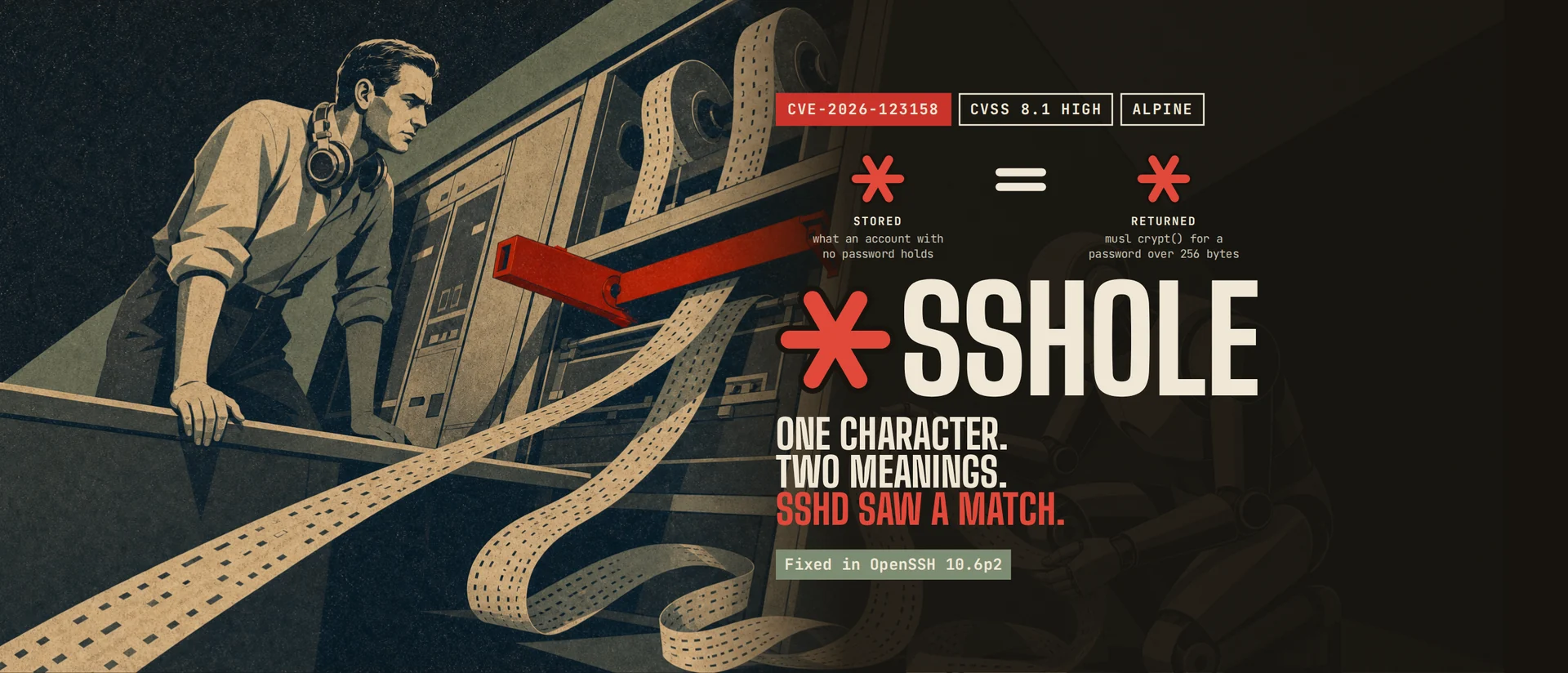

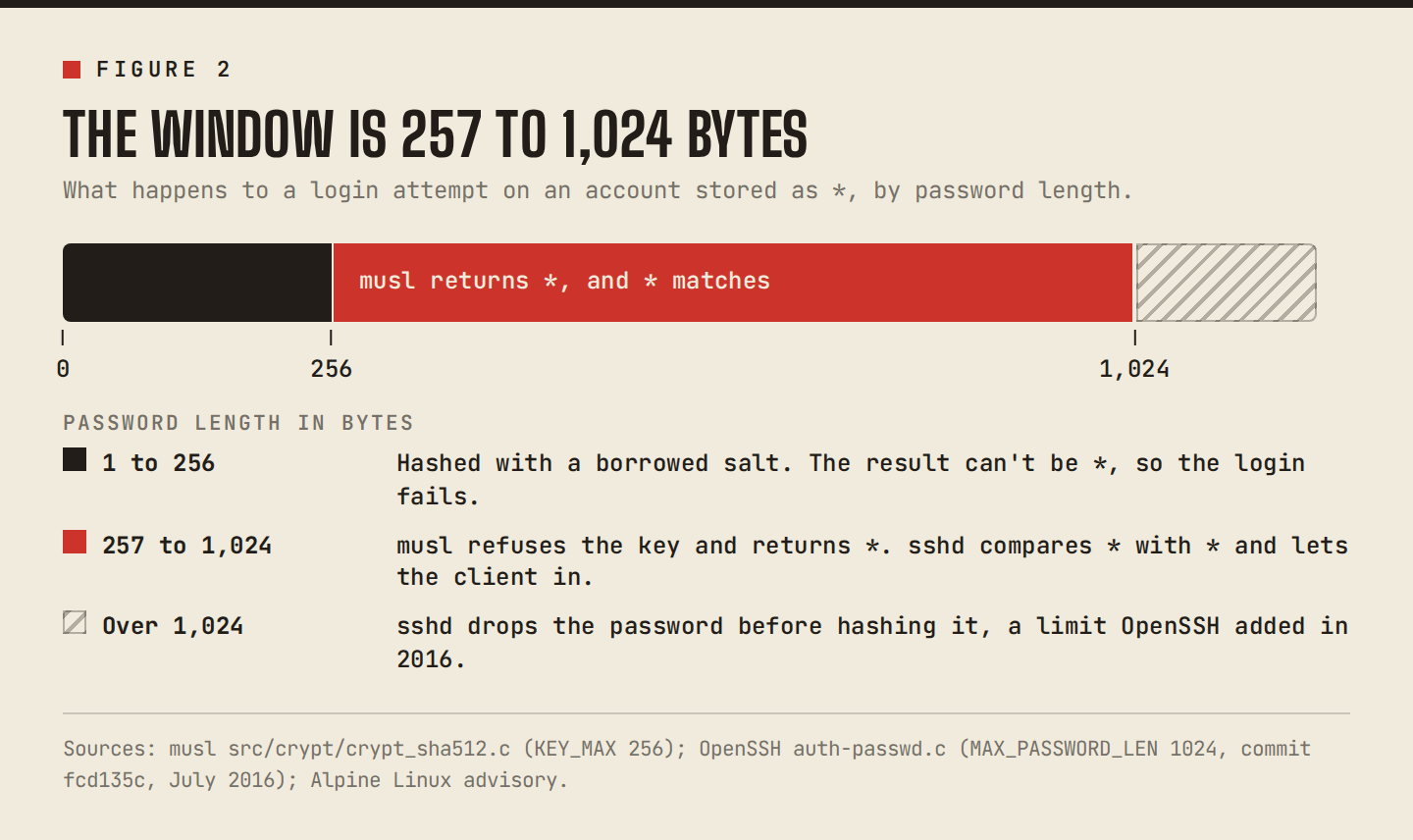
Today Alpine and the OpenSSH team shipped a fix for a password bypass in sshd, now tracked as CVE-2026-123158. On Alpine, and on other Linux systems built on the musl C library, an account with no password could be logged into with any password between 257 and 1,024 bytes long. The accounts at risk are the ones we think of as the safest: key-only users, directory users, and the default alpine user on Alpine's official cloud images.
This post covers how the bypass works across musl, OpenSSH and Alpine, why it went unnoticed for ten years, which machines are exposed, how to check yours, and what it says about where security work is going.
Key findings
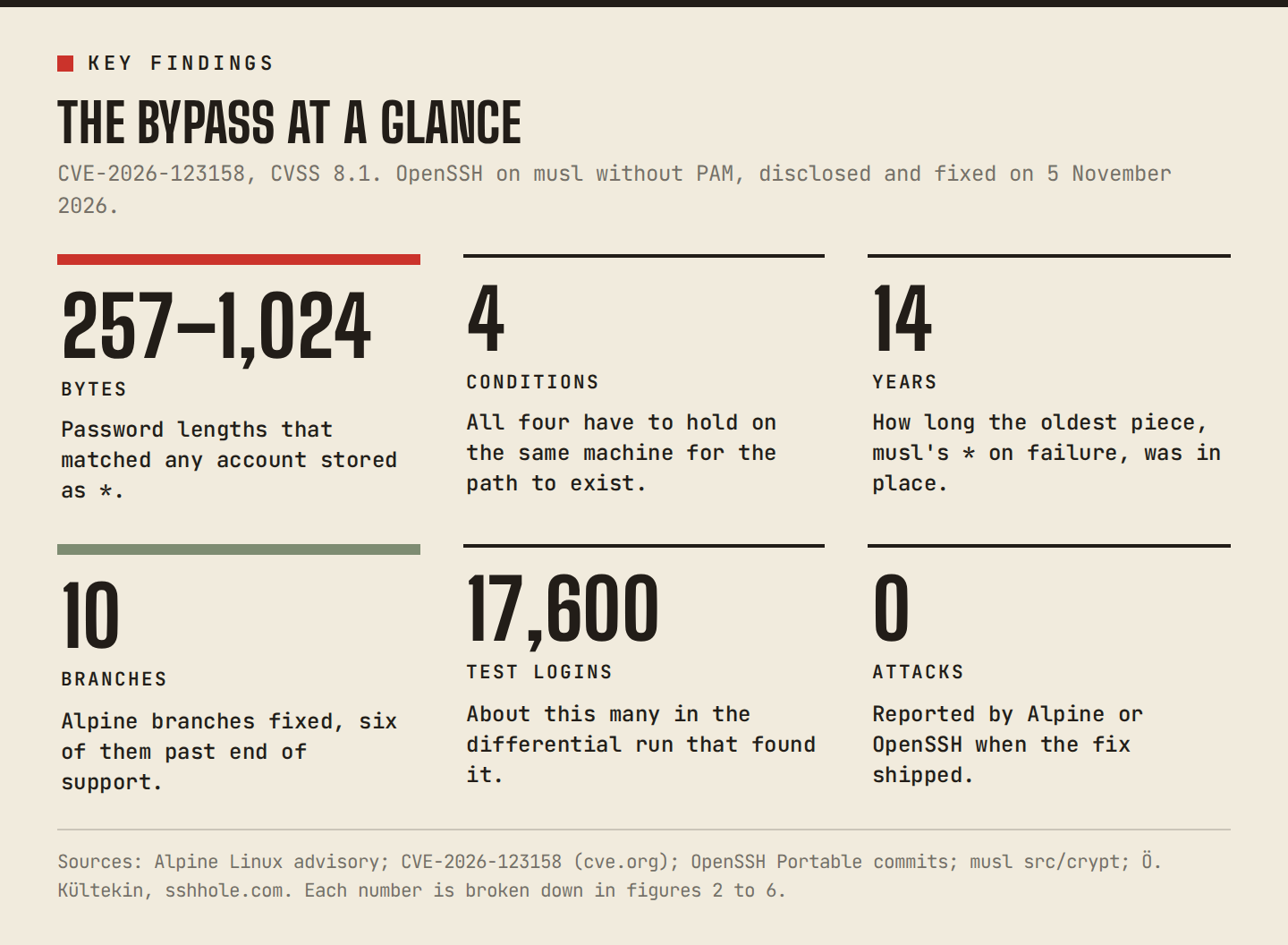
- It's real, and it has a CVE. MITRE published CVE-2026-123158 with a CVSS 3.1 score of 8.1 [14]. The musl source and the OpenSSH fix commit show the whole path. musl's
crypt()returns the string*when a password is over 256 bytes [3].*is also what Alpine stores for accounts with no password [1]. Without PAM, sshd compared the two strings, and they were equal [4]. - Each project followed its own rules. OpenSSH says the root cause is outside sshd [2]. musl documents its
*in the source. The bug lives where the two meet. - Each piece was a defense. musl returns
*so a failed hash can never match a real one (2012). OpenSSH hashes with a real salt so attackers can't time their way to valid usernames (2016). Alpine stores root as*(since 3.16, 2022). - The path needs four things at once. sshd without PAM, password logins on, an account stored as
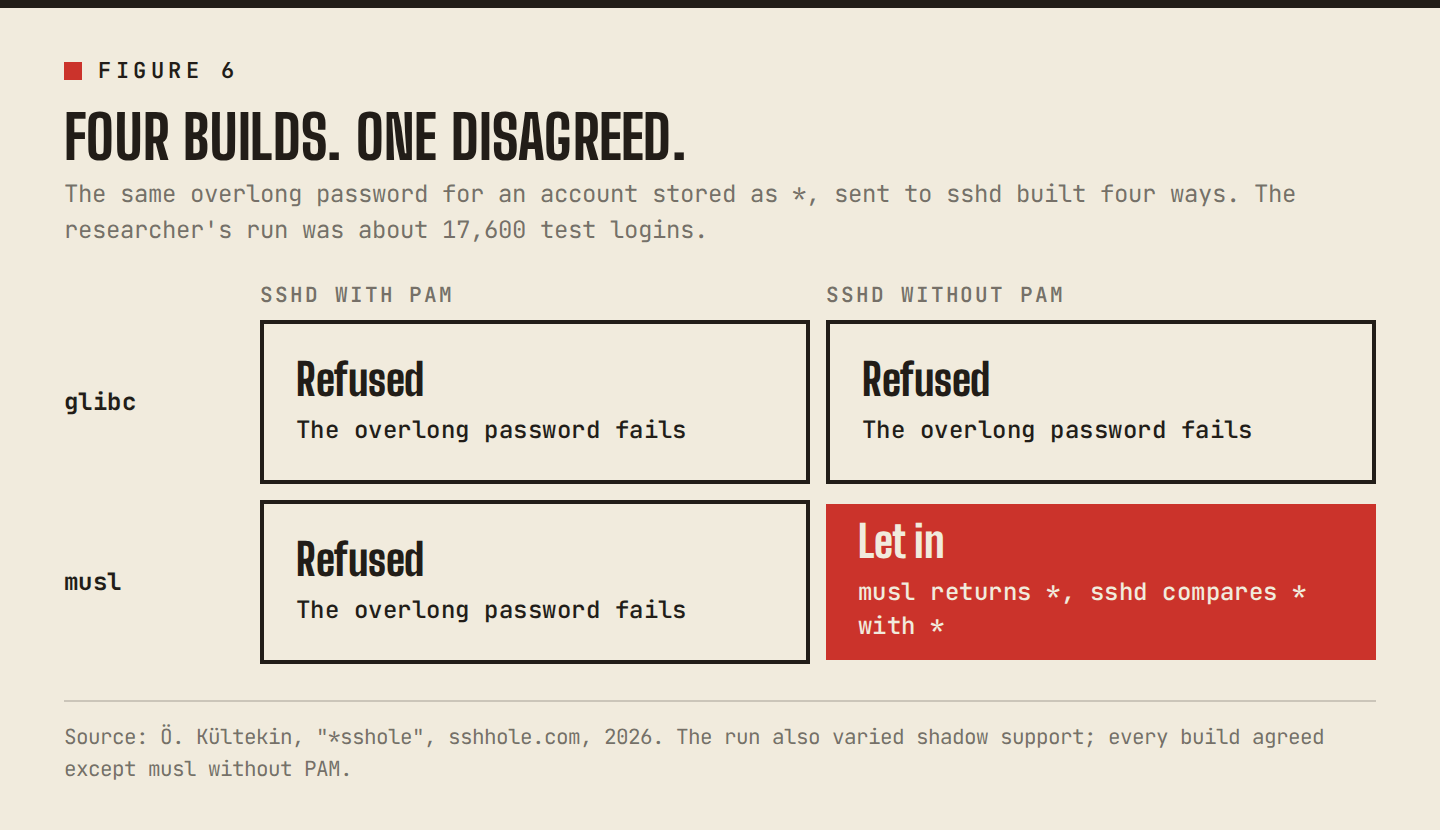
*, and a$5$or$6$hash somewhere on the machine. Most Alpine containers don't run sshd at all. Alpine's official cloud images from 3.18.11 to 3.24.3 have all four as soon as someone sets a password [1]. - Agents found it. The researcher built sshd several ways, ran about 17,600 test logins, and only musl without PAM gave a different answer [5]. OpenSSH says many of its recent reports come from AI models [2].
1. What happened
On 5 November Alpine published an advisory for openssh-server [1] and OpenSSH released 10.6p2 [2]. Özgün Kültekin of Wakefield reported it and named it "*sshole" [5]. Damien Miller and Darren Tucker wrote the fix in OpenSSH, Timo Teräs helped with the analysis and Natanael Copa packaged it for Alpine [1]. MITRE assigned CVE-2026-123158 later that day and scored it 8.1 (High) under CVSS 3.1 [14]. The score rates attack complexity as high, which matches the four conditions in section 4. Neither Alpine nor OpenSSH reported anyone using it.
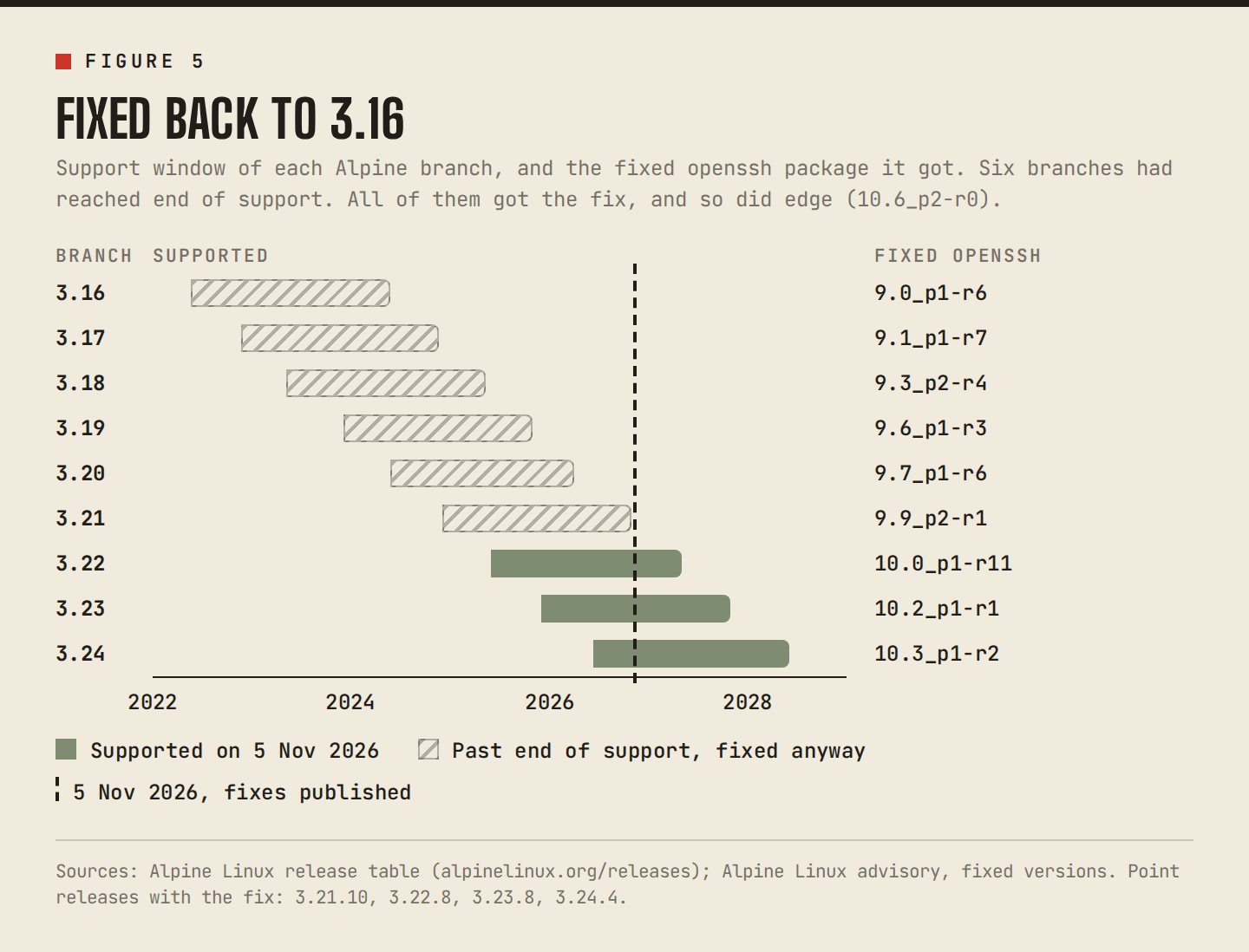
Alpine shipped fixed packages for every branch from 3.16 to edge, including six branches that had already reached end of support. Figure 5 below has the full list.
2. How the path works
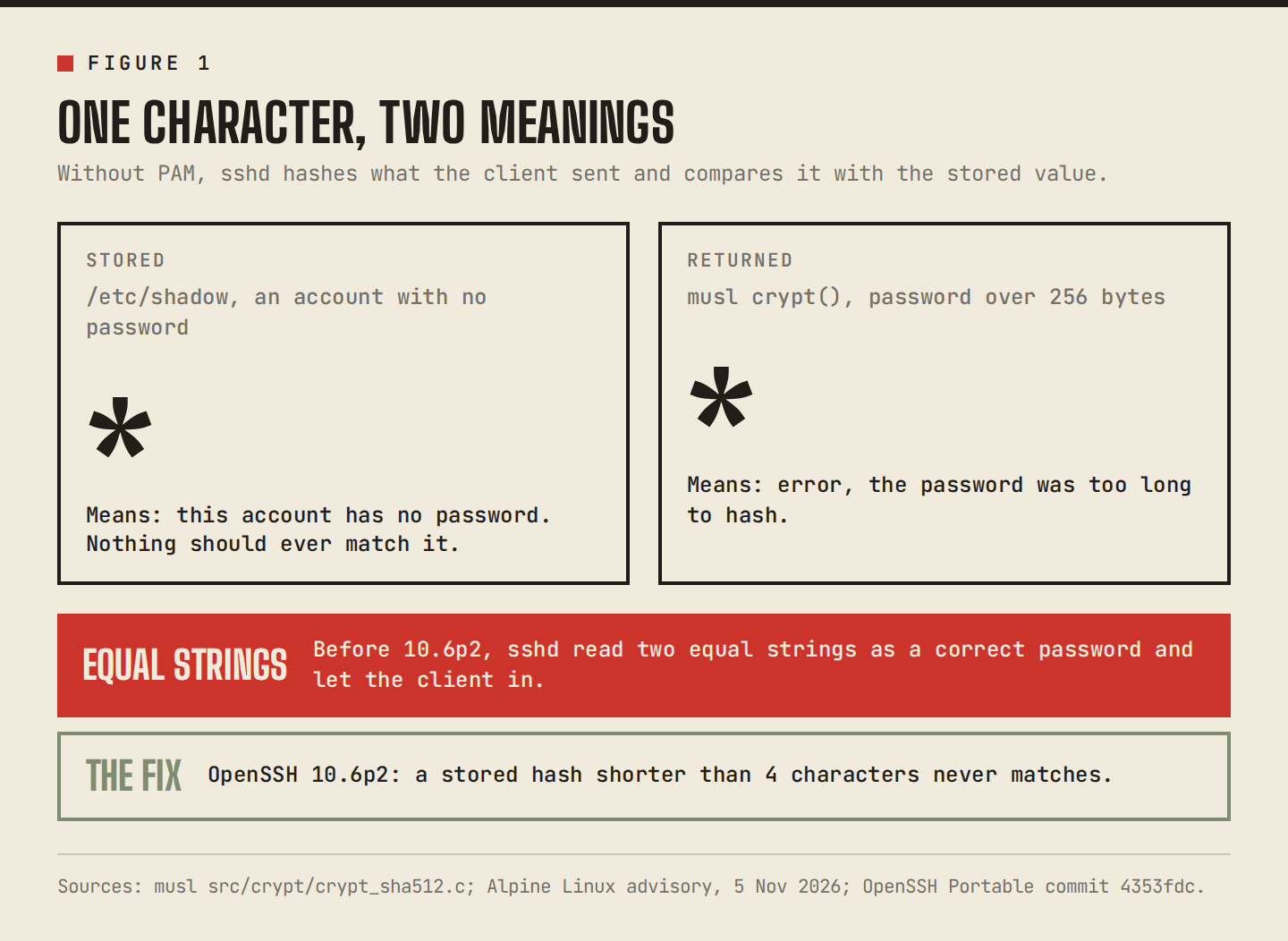
Most Linux distributions check SSH passwords through PAM. Alpine's default openssh-server package is built without it. So sshd checks the password itself. It reads the stored hash from /etc/shadow, hashes what the client sent with the same salt, and compares the two strings. Equal strings mean the password is right.
Three details meet in that comparison.
The stored value. An account with no password has * in its shadow field. Nothing hashes to *, so nothing should ever match it. On Alpine, root ships this way in the base image, and so do key-only users created without a password, users from directory services and the alpine user on the cloud images [1].
The salt. * is one character, too short to hold a salt. When the stored value can't serve as a salt, sshd borrows one from the first account in the password database that has a real hash [6]. OpenSSH added this in 2016 to fix CVE-2016-6210. Back then an attacker could tell real usernames from fake ones by how long the hash took [7]. With a real salt, every check takes the same time.
The error value. musl's SHA-256 and SHA-512 crypt() refuse passwords over 256 bytes, and when they refuse, crypt() returns *. The comment at the top of musl's file says it in one line: on error "*" is returned. [3]
Put them together. A client asks to log in as an account stored as * and sends a password over 256 bytes. sshd borrows a $6$ salt from another account. musl refuses the long password and returns *. sshd compares * with the stored *. They're equal, and the client is in.
The window has an upper edge too. In July 2016 OpenSSH started dropping passwords over 1,024 bytes before hashing them, so clients couldn't burn the server's CPU with huge passwords [8]. That's the other end of the range Alpine gives.
sshd already knew crypt() can fail. Since 2012 it has checked for crypt() returning a null pointer, which is how a failure is usually reported [9]. libxcrypt, the library behind crypt() on many glibc distributions, documents its own error value as a string that starts with *, is shorter than 13 characters and "will not compare equal to setting" [10]. musl's error value is a bare *, the exact value a passwordless account stores. Each library reports failure its own way, and sshd only knew one of them.
The fix in OpenSSH is a few lines in auth-passwd.c: a stored hash shorter than four characters never matches [4]. The commit message is direct about it: "We do not consider the root cause to be within OpenSSH but we are well equipped to avoid it."
3. Ten years of good decisions
What strikes me most about this bug is that careful people wrote every piece of it, each for a good reason.
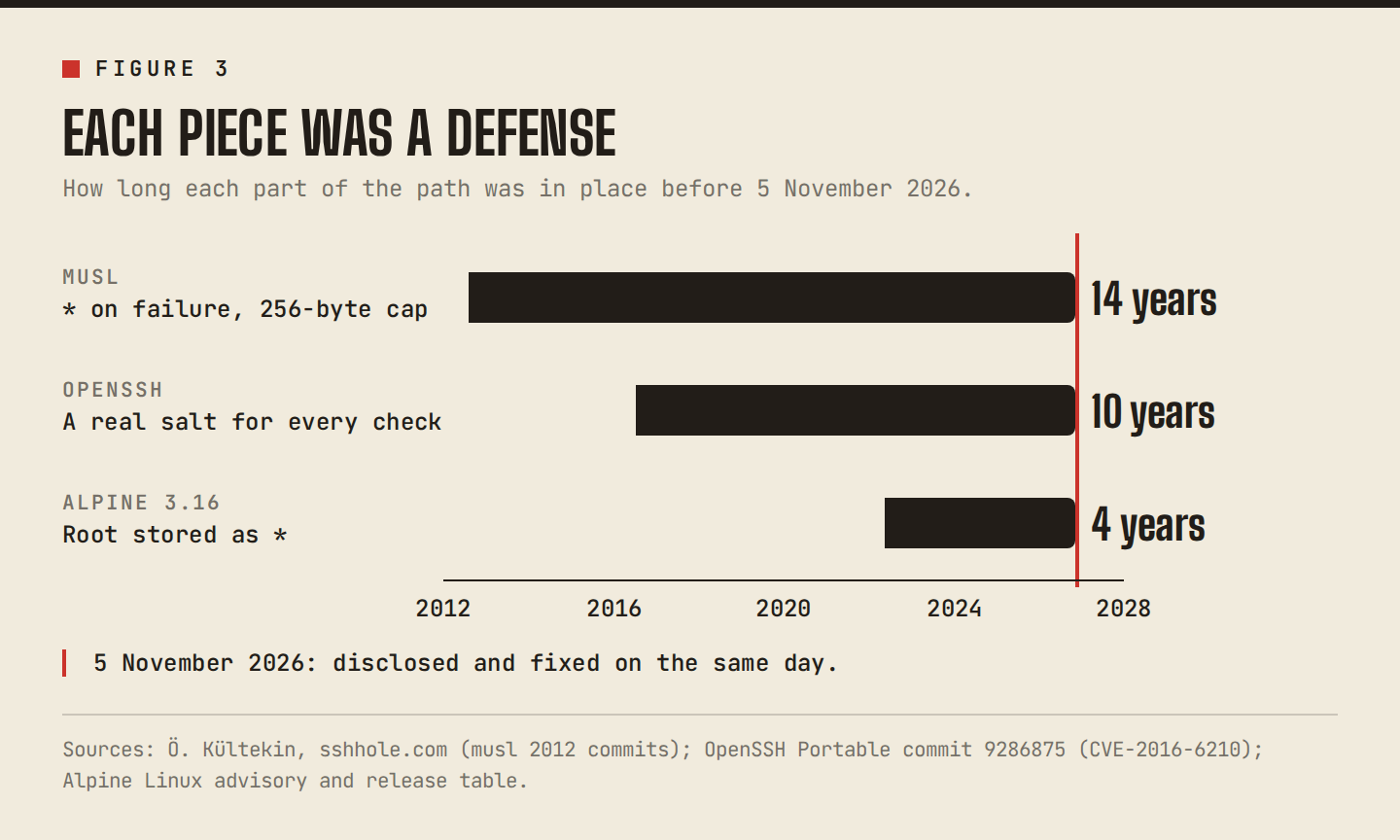
In 2012 musl started returning * when a hash fails. A real hash never looks like *, and code that never checks for a null pointer keeps running [5], [10]. In 2016 OpenSSH started hashing with a real salt to stop a username leak [7]. Since 3.16, Alpine stores root as *, so no password can log in as root [1].
There were two near misses. In December 2024 the musl mailing list discussed passwd crashing on Alpine with long passwords, the same 256-byte limit and the same * [11]. It was handled as a crash. And on 30 October 2026 OpenSSH changed the borrowed-salt code for bcrypt hashes [12]. The bypass went public six days later.
So who owned this bug? musl can point at its documented error value. OpenSSH said the root cause is outside sshd. Alpine shipped both as they were. Each answer holds up, and the path was still there.
4. Who has the whole path
The path needs four conditions on the same machine.
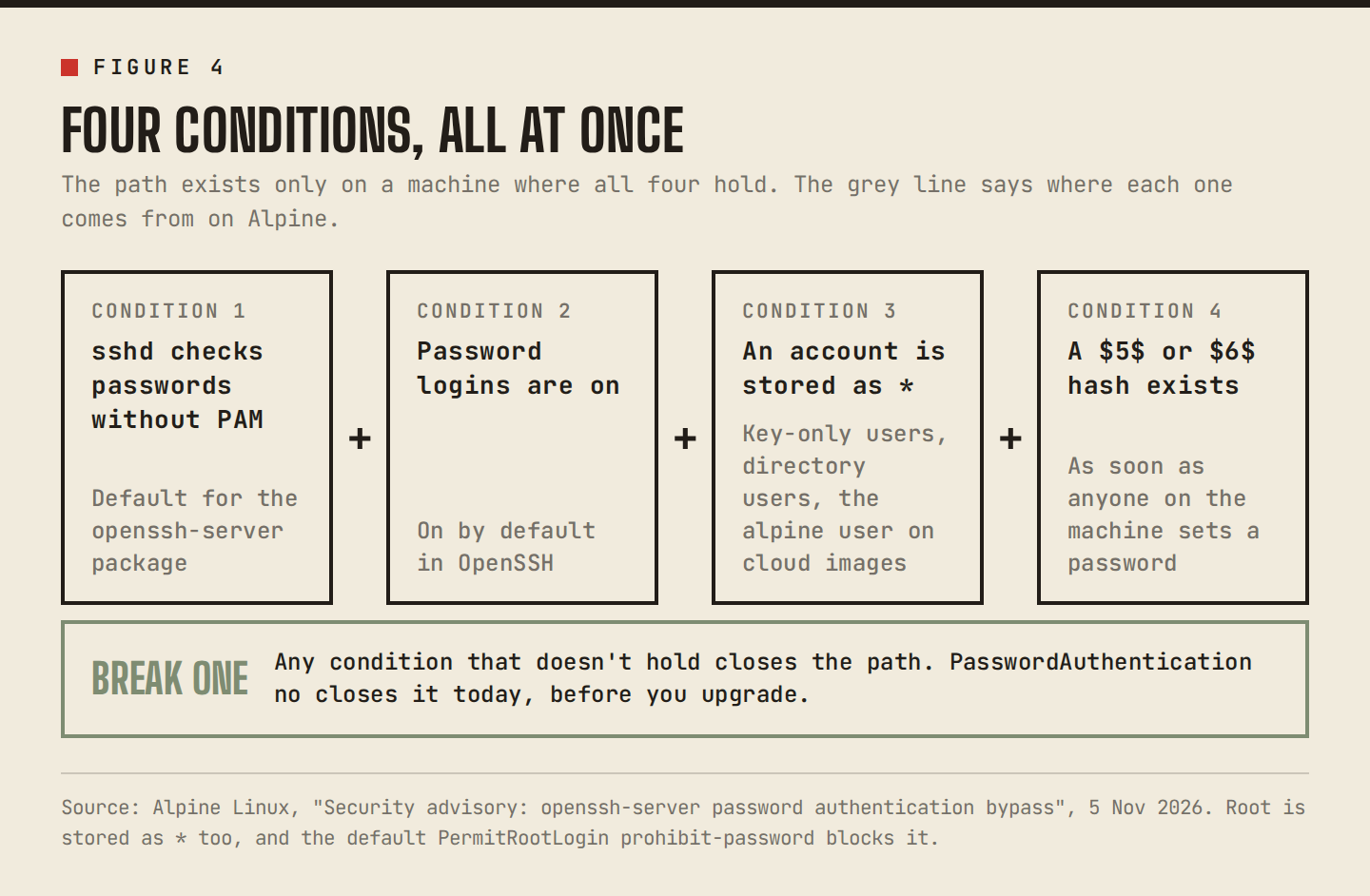
That makes it much narrower than "every Alpine box":
- Containers without sshd have nothing to reach. Many Alpine containers are like this, including the official
alpineimage. - Alpine servers and VMs running
openssh-servermeet conditions 1 and 2 by default. They're exposed once an account stored as*and a real hash live on the same machine.rootis stored as*, but the defaultPermitRootLogin prohibit-passwordblocks it. Any other*account that can become root, throughdoasfor example, is still a path to root [1]. - Alpine's official cloud images from 3.18.11 to 3.24.3 ship an
alpineuser stored as*with passwordlessdoas. They're safe on first boot and exposed as soon as any account on the machine gets a password [1]. Images set up by cloud-init writePasswordAuthentication noand aren't affected. openssh-server-pamwithUsePAM yesgoes through PAM and isn't affected [1].- Other musl systems. The researcher lists OpenWrt, Buildroot and Yocto builds that ship OpenSSH without PAM [5]. Many of those use Dropbear, which is safe here [5].
- glibc distributions such as Debian, Ubuntu and Fedora gave the expected answer in the researcher's tests [5].
A scanner that matches package versions will flag openssh-server on every Alpine image you have. Only some of those machines have all four conditions. Telling them apart means looking at each machine's sshd config and its accounts, and that's the same question we keep coming back to: is there a path, and where does it go?
5. How to check a machine
These commands only read. Run them as root on the machine.
# Which openssh packages are installed, and which versions?
apk list -I 'openssh*'

# How sshd is actually configured. If usepam is missing or "no",
# passwords are checked without PAM.
sshd -T | grep -Ei '^(usepam|passwordauthentication|permitrootlogin) '

# Accounts stored as "*" (no password). Prints names only.
awk -F: '$2 == "*" { print $1 }' /etc/shadow

# How many accounts have a SHA-256 or SHA-512 hash. Prints a number only.
awk -F: '$2 ~ /^\$[56]\$/ { n++ } END { print n+0 }' /etc/shadow
The machine has the whole path if sshd runs without PAM, passwordauthentication is yes, the third command prints at least one name and the last one prints more than zero.
To look for use, search the auth log for password logins:
grep 'Accepted password for' /var/log/messages
A password login to any account from the * list shouldn't be possible. If you find one, or can't rule one out, Alpine's advice is to treat the machine as compromised and to review doas use, new users, changed files and authorized_keys [1].
6. The fix
Upgrade, then restart sshd. The upgrade alone leaves the old sshd running [1].
apk upgrade -U -a
rc-service sshd restart
Rebuild your images. If a Dockerfile runs apk add openssh-server, build it again without the layer cache. Otherwise the old package comes back from the cache.
docker build --no-cache -t your-image .
An apk upgrade inside a running container disappears the next time the container is replaced, so the rebuild is what makes the fix stick. Cloud instances launched from images older than 3.21.10, 3.22.8, 3.23.8 or 3.24.4 need the upgrade or the setting below [1].
If you can't upgrade today, turn password logins off. Check that your key login works first, and keep a session open while you restart [1].
echo 'PasswordAuthentication no' > /etc/ssh/sshd_config.d/00-no-passwords.conf
sshd -t && rc-service sshd restart
Alpine's default sshd_config reads that folder from 3.19 onward. On older releases, set PasswordAuthentication no in /etc/ssh/sshd_config itself [1].
7. What I take from this
Finding just got cheaper. The researcher built sshd several ways, sent about 17,600 strange logins at the builds, and looked for the one that answered differently [5].
OpenSSH says it has "received a large number of security bug reports, many of which are findings from AI models or made with AI assistance," and that it will release more often for a while to get fixes out faster [2].
So what's hard now? I think it's what comes after the finding. Which of my machines actually have the path? And did the fix reach every image, every pin and every running sshd? The OpenSSH change is a few lines long. I think most of the effort now goes into getting it onto every machine that needs it.
This bug also sat between projects that each did their job well. I think we'll see more like it. When code from different teams is put together, the gaps are where nobody is looking. The way to find them is to follow the input from the network all the way to the line that lets it in, across every project it passes through.
What we're building at Arvion
That's the question our product-security team works on: can attacker input reach the flaw in your system? It reads your code, open-source dependencies, infrastructure as code and the AI agents in your repositories. For each finding, it traces whether attacker input can reach the vulnerable code and marks each step of the path as traced or assumed.
For findings with a real path, it writes the fix and opens a pull request. Your engineers review the evidence and decide what gets merged.
References
- Alpine Linux. "Security advisory: openssh-server password authentication bypass," 5 November 2026. alpinelinux.org
- D. Miller. "Announce: Portable OpenSSH 10.6p2 released," oss-security, 5 November 2026. openwall.com; OpenSSH release notes
- musl libc.
src/crypt/crypt_sha512.c,KEY_MAXand the*return. git.musl-libc.org - OpenSSH Portable. Commit 4353fdc, "avoid password authn bypass," 4 November 2026. github.com
- Ö. Kültekin. "*sshole," 2026. sshhole.com; J. Schaumann, ""sshole": password authentication bypass: OpenSSH + musl libc," oss-security, 5 November 2026. openwall.com
- OpenSSH Portable.
openbsd-compat/xcrypt.c,pick_salt(), and commit dbf788b, "Search users for one with a valid salt," July 2016. github.com - OpenSSH Portable. Commit 9286875, "Determine appropriate salt for invalid users" (CVE-2016-6210), July 2016. github.com; NVD
- OpenSSH Portable. Commit fcd135c, "Skip passwords longer than 1k in length," July 2016. github.com
- OpenSSH Portable. Commit 7584cb1, "Handle crypt() returning NULL," April 2012. github.com
- libxcrypt.
crypt(3)manual, "Return values." github.com - R. Felker. musl mailing list, 30 December 2024. openwall.com
- OpenSSH Portable. Commit 84f8f46, "fix fake password salt generation for bcrypt hashes," 30 October 2026. github.com
- Alpine Linux. Release branches and end of support. alpinelinux.org
- MITRE. CVE-2026-123158, CVE Record, published 5 November 2026. cve.org; NVD